In the article comparing Vedic vs Western astrology, I made a list of techniques used to predict life events. Based on my research, planetary time periods calculated through the Vimshottari Dasha system are the most accurate method of predicting life events. The classics on Vedic astrology write extensively about this method, and I have personally found it very accurate.
How the Vimshottari Dasha system works
It is based on the Moon’s position. The Moon travels 13 degrees 20 minutes in a day, and the path it covers is called a lunar mansion or Nakshatra. It takes Moon ~27 days to travel across the entire zodiac (360 degrees) so there are 27 Nakshatras (click to read more), which play a pivotal role in Vedic astrology.
Each Nakshatra is ruled by a planet for a specific number of years (time period) based on the Vimshottari Dasha system. Depending on the Moon’s degree in your birth chart, you go through the time period of the Nakshatra’s ruler, and that planet affects your life the most. Take a look at this table.
| Sequence | Nakshatra | Degree (longitude) of the Moon | Ruler | Number of years |
| 1 | Ashwini | 0 - 13 degrees 20 minutes | Ketu | 7 years |
| 2 | Bharani | 13 degrees 20 minutes – 26 degrees 40 minutes | Venus | 20 years |
| 3 | Krittika | 26 degrees 40 minutes – 40 degrees | Sun | 6 years |
| 4 | Rohini | 40 degrees – 53 degrees 20 minutes | Moon | 10 years |
| 5 | Mrigashira | 53 degrees 20 minutes – 66 degrees 40 minutes | Mars | 7 years |
| 6 | Ardra | 66 degrees 40 minutes – 80 degrees | Rahu | 18 years |
| 7 | Punarvasu | 80 degrees – 93 degrees 20 minutes | Jupiter | 16 years |
| 8 | Pushya | 93 degrees 20 minutes – 106 degrees 40 minutes | Saturn | 19 years |
| 9 | Ashlesha | 106 degrees 40 minutes – 120 degrees | Mercury | 17 years |
| 10 | Magha | 120 degrees – 133 degrees 20 minutes | Ketu | 7 years |
| 11 | Purva Phalguni | 133 degrees 20 minutes – 146 degrees 40 minutes | Venus | 20 years |
| 12 | Uttara Phalguni | 146 degrees 40 minutes – 160 degrees | Sun | 6 years |
| 13 | Hasta | 160 degrees – 173 degrees 20 minutes | Moon | 10 years |
| 14 | Chitra | 173 degrees 20 minutes – 186 degrees 40 minutes | Mars | 7 years |
| 15 | Swati | 186 degrees 40 minutes – 200 degrees | Rahu | 18 years |
| 16 | Vishaka | 200 degrees – 213 degrees 20 minutes | Jupiter | 16 years |
| 17 | Anurada | 213 degrees 20 minutes – 226 degrees 40 minutes | Saturn | 19 years |
| 18 | Jyeshta | 226 degrees 40 minutes – 240 degrees | Mercury | 17 years |
| 19 | Mula | 240 degrees – 253 degrees 20 minutes | Ketu | 7 years |
| 20 | Purva Ashadha | 253 degrees 20 minutes – 266 degrees 40 minutes | Venus | 20 years |
| 21 | Uttara Ashadha | 266 degrees 40 minutes – 280 degrees | Sun | 6 years |
| 22 | Shravana | 280 degrees – 293 degrees 20 minutes | Moon | 10 years |
| 23 | Dhanishta | 293 degrees 20 minutes – 306 degrees 40 minutes | Mars | 7 years |
| 24 | Shatabhishak | 306 degrees 40 minutes – 320 degrees | Rahu | 18 years |
| 25 | Purva Bhadrapada | 320 degrees – 333 degrees 20 minutes | Jupiter | 16 years |
| 26 | Uttara Bhadrapada | 333 degrees 20 minutes – 346 degrees 40 minutes | Saturn | 19 years |
| 27 | Revati | 346 degrees 40 minutes – 360 degrees | Mercury | 17 years |

An example calculation
Suppose you were born on 11 April 1990 at 18:30 in London. In the resulting birth chart, the Moon is at 15 degrees of Libra. It has therefore travelled through six signs of 30 degrees each, from Aries to Virgo, and another 15 degrees through Libra. The Moon’s longitude is 195 degrees: (6 × 30) + 15.
The table shows that the Moon is in Swati, which is ruled by Rahu. It has already travelled 8 degrees 20 minutes of Swati’s 13 degrees 20 minutes: 195 − 186.33. You therefore go through the remaining portion of Rahu’s period according to the following formula.
Time period of Rahu left = (13.33 - 8.33)/ 13.33 * 18 years = 6 years and 9 months
After you have finished the remaining time period of Rahu, you'll enter the time period of the next ruling planet in the sequence (refer table above), which in this case is Jupiter for 16 years, followed by Saturn for 19 years and so on.
Breaking down the time periods
*You can move to the next section if you are more interested in applying the method.
The main time period is further broken down to a sub-time period and a sub-sub time period. For the sake of simplicity, I call them time period#1, #2, and #3. So how are they broken down? if you are starting a time period#1 of a new planet, then time period#2, and #3 are also of the same planet. Time period #3 changes first according to the sequence in the table. Once it completes a cycle, time period #2 changes. Time period #1 changes only after the cycle of time period #2 is complete.
Suppose you are starting a Sun time period. Time periods #1, #2 and #3 are all ruled by the Sun. The next time period will be Sun-Sun-Moon, followed by Sun-Sun-Mars....all the way till Sun-Sun-Venus, and then it becomes Sun-Moon-Moon, and the same cycle follows, until time period #1 changes.
Another interesting question is how to calculate the duration of these time periods. Let's take Sun-Sun-Sun as an example, as per the table the duration of Sun's time period is 6 years, and as per vimshottari dasha system the life of a person is 120 years, for the purpose of calculations.
So, the duration of Sun-Sun will be = 6 x 6/120 = 109 days, and Sun-Sun-Sun = 109* 6/120 = 5 days.
You don't need to worry about the calculations they've already been done on this website.

How to use the Dasha table
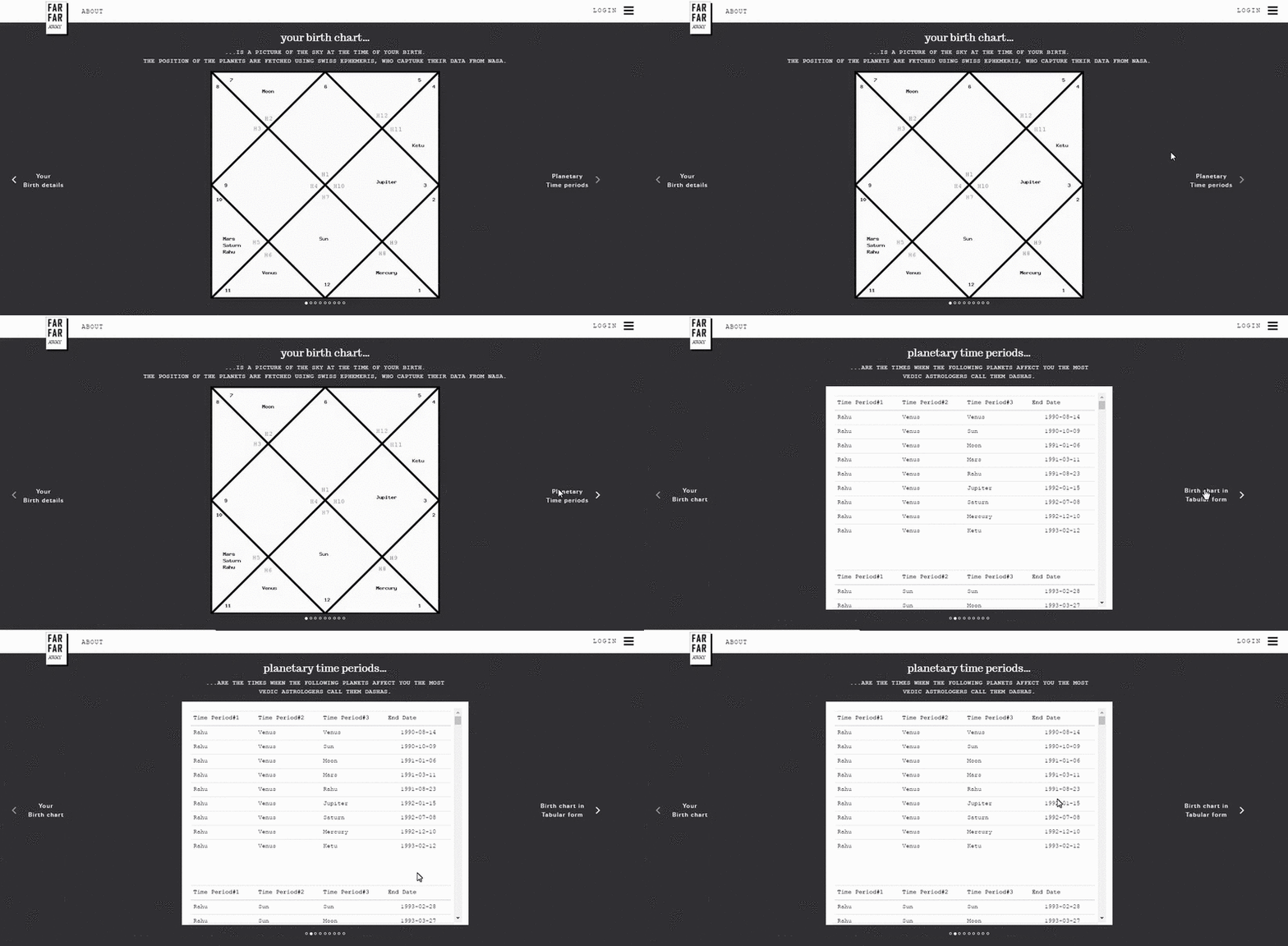
The life of every human being is taken as 120 years and it is divided into different phases controlled by different planets. You could find the planets controlling your life right now by navigating to the table on farfaraway that says "planetary time periods" (as shown above). The table has four columns: 1. Time period #1, the main period. 2. Time period #2, the sub-period. 3. Time period #3, the sub-sub-period. 4. The end date, which shows how long the phase lasts. Now, the planets in time periods #1 & #2 are responsible for creating the circumstances for a life event to take place whereas the planet in time period #3 is responsible for executing that life event at that time.
Let's take an example. If the planet in time period #1 is Jupiter, the planet in time phase #2 is the lord of the 7th house, and the planet in time phase #3 is sitting in the 11th house then this time period would create a very high possibility of marriage. This is because Jupiter (blessings) joins the lord of the 7th house (marriage) and the planet in the 11th house (desires). I hope you are able to see this connection. Similarly, if at a certain time the planets controlling your life are having a strong connection with the career-related houses (the 10th and the 6th) then a career-related event is likely to happen at that time.
Using Dashas to predict marriage
Check how planets are linked in your birth chart e.g. if you are trying to predict your time of marriage then see which planets are ruling the 7th house in your birth chart, which planets are sitting in it, and which planets are aspecting it. Now do the same for the 11th house. Now check when in the future are you going to go through a combination of planets which influence the marriage house (7th) and the house of desires (11th). The phase of those planets would be your time of marriage :)
Thank you for your time.
If you'd like to request a personalised reading Request a reading